Billions spent. Now what?
The money is flowing into AI infrastructure. The returns are supposed to come from applications. Where are they?
“Cash rules everything around me. C.R.E.A.M. get the money— dollar dollar bill, yo.”
—Wu-Tang Clan
Goldman Sachs forecasts that investment in AI will approach $200 billion globally by 2025. Sam Altman, the founder of OpenAI, seeks trillions of dollars to reshape the business of chips and AI. Nvidia, with its shovel-selling business, has just had the largest single-day gain in market cap in history - $247 billion added - and shot past Google to become the third most valuable US company. VC and PE money doesn’t flow much at the moment - but when it does, it goes to AI companies.
Billions have already been invested, and much more will be, in one of the greatest bull runs the world has ever seen.
The key word here is invested. All of the money that was and will be spent was spent in expectation of a positive return - income or price appreciation - with statistical significance.
💡 The statistical significance part is often overlooked.
This is the core premise of investing. $1 in a year is worth less than $1 today, so we forgo today’s consumption in order to consume more in the future. And we want to be fairly certain the investment will pay off.
You see where I’m going with this?
Where the money goes: platforms
Start with who is actually spending. Google, Amazon (AWS) and Microsoft (Azure) are sitting on enormous cash reserves and have been looking for growth. Acquisitions are hard - there are few suitable targets and antitrust regulators are watching - so the cash goes into the next generation of cloud infrastructure instead.
The accounting makes this painless. When a hyperscaler buys chips from Nvidia, the purchase is a capital expenditure, not an operating expense. It never hits the P&L as a lump; it gets depreciated over years. The build-out looks free on the quarterly numbers, and it happens to be a reasonable way to put idle cash to work without paying tax on it.
Then there is the arms race. If one of these players slowed down, customers would read it as falling behind - in technology, capability, reliability - and competitors would take share. Nobody can afford to blink.
So the platforms have been wildly successful. GPTs, Soras, Midjourneys, H100s, ElevenLabs, DALL-Es are keeping us in a constant state of amazement. Sagemakers, Vertexes (Vertices?) and Azure GPT deployments are being sold to anyone who wants to buy, and it’s not uncommon to get 30-40% discounts on payment plans. All in the name of gaining and holding market share while the infrastructure gets built.
Watch: Nvidia GTC 2024 keynote
But most of this investment is underwritten by a promise: that AI will improve productivity. Productivity is the core notion of technology - a man with a rake can do a fraction of what a man with a combine harvester can. A man with magical alien technology? The sky is the limit. And any productivity gain would be a welcome gift, because the population of every advanced economy is shrinking and the pension maths is getting ugly. (The socioeconomic side deserves its own post.)
Did those gains happen yet?
Where the returns should come from: applications
The rate of progress in AI is mind-blowing, unlike anything in the history of the world. The applications - the business use cases - are lagging behind it.
This is not to say there aren’t any. Healthcare, pharma, finance, content creation and the creative industries are all poised to be turned on their heads.
It’s a weird world we’re living in. Google being evil. Apple being a cheapskate. Meta doing the best for the community. The only constant - Micro$oft
But most of the money that isn’t going to the platforms is going to Generative AI, and at this point the real use cases mostly look like this:
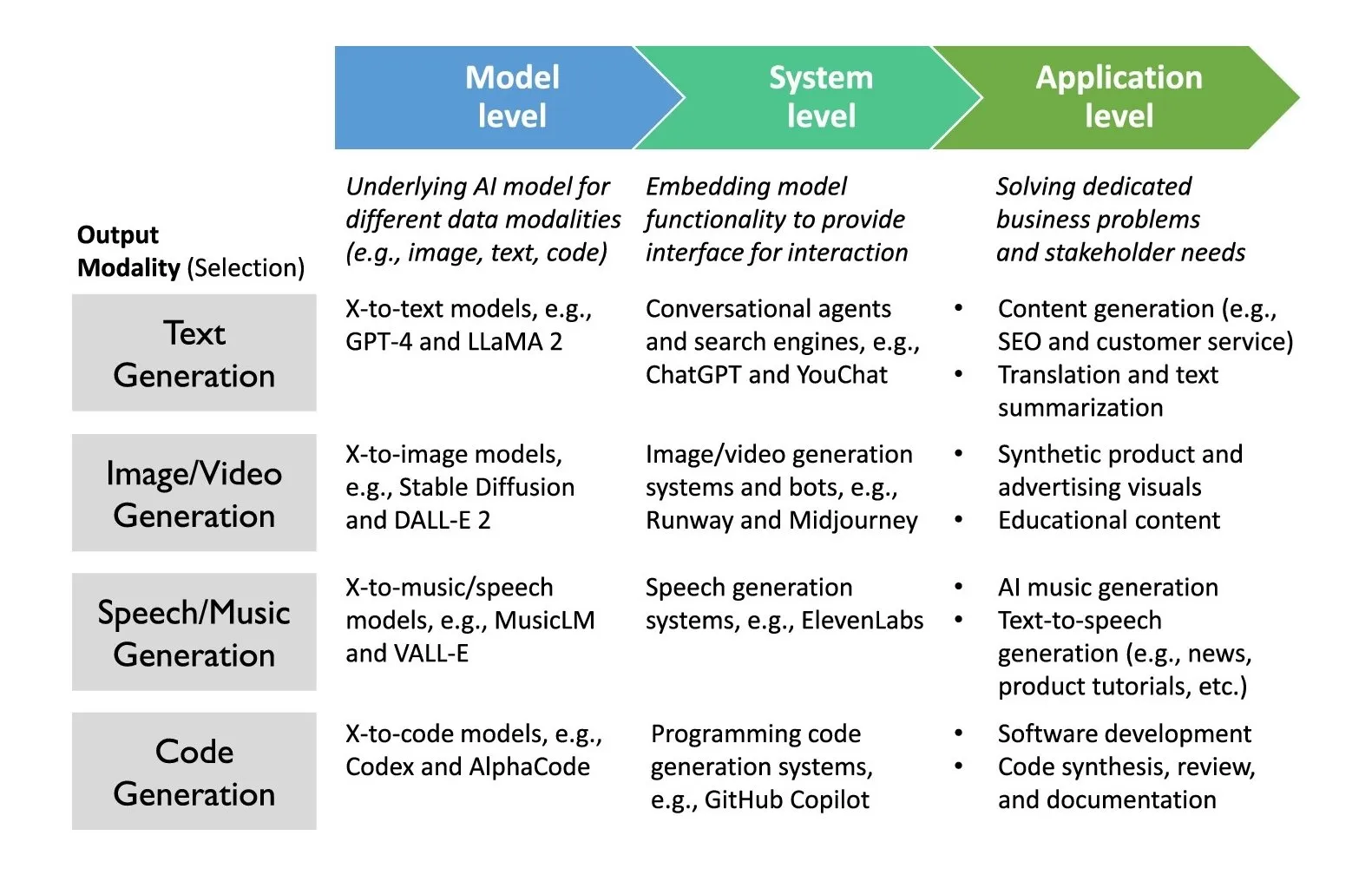
Useful. Not trillions-of-dollars useful. That leaves the open questions that everyone who put money in is implicitly betting on: what is the real value today, and how much of tomorrow’s value is guesswork about adoption speed? How big is the market really? What happens to the return if regulation or public sentiment turns? And is this a durable shift, or another excitement-money-crash cycle like dotcom and, more recently, crypto?
No one knows the right answers to these questions, least of all me. What we do have is a fairly well-documented previous attempt.
The dotcom checklist
The Corporate Finance Institute attributes the dotcom bubble to three things, and offers three ways to avoid the next one.
The causes:
- Overvaluation. IPO-era internet companies were priced with high multiples and no solid valuation models. Analysts skipped fundamentals and looked at website traffic instead of revenue. By P/E, more than 40% of dotcoms were overvalued.
- Abundance of venture capital. Cheap money from low interest rates, and few barriers to raising it for anything with “.com” in the name.
- Media frenzy. Business publications pushed the “get big fast” mantra and wildly optimistic return expectations. Greenspan’s “irrational exuberance” speech was in December 1996 - and the market ran for three more years anyway.
The remedies:
- Proper due diligence - look at cash flow generation and the business model, not the story.
- Remove the “investment of expectation” - stop funding entities that have yet to prove they can generate cash.
- Avoid high-beta companies - stocks that rise more than the market on the way up fall more than the market on the way down.
Now hold that list against AI in March 2024.
Abundance of capital? Yes, without question. The VC that is moving is moving to AI, and the hyperscalers are spending from cash reserves so large the accounting barely registers it.
Media frenzy? Every earnings call, every keynote, every newspaper. Greenspan-level warnings are being issued weekly and the market shrugs.
Overvaluation? This is the one that isn’t clear-cut. The application layer is being funded on expectation - the Feuerriegel figure above is the current state of “fundamentals” - and that is precisely the cause number one and remedy number two. But the platform layer, where most of the money is, has real revenue, real margins and real profit. Which brings us to the obvious comparison.
But… This Time Is Different. Right?
This Time Is Different: Eight Centuries of Financial Folly was published in 2009, right after another crash. The authors show that the central bankers, policy makers and investors involved in every financial bubble were utterly convinced that, in terms of economic events, this time was different. We learn very little from history; the tectonic shifts happen at regular intervals. Their rule of thumb: when you hear this time is different, don’t walk, run.
And yet, standing at the start of the AI era, the phrase does resonate.
Have a look at the NASDAQ Composite [IXIC] in the run-up to the dotcom crash, and then over the last five years. Notice any similarities?
.2TgZN2pi_2dUPeQ.webp)
.BcIvFTkw_Z1nfzmR.webp)
The Nvidia case
Nvidia sits at the bottom of the AI pyramid - everything above it runs on their chips - so it is where the “is this a bubble?” question gets asked loudest. The concern is straightforward: the current build-out may produce an oversupply of infrastructure before the application layer can monetise it, and the comparison to Cisco has become prevalent.
The parallel is real. In the early days of the internet Cisco was the “picks and shovels” company: servers, fibre, the telecom backbone that reshaped the world. Without that build-out there is no social media, no YouTube, no Zoom (remember Skype?), no smartphone proliferation. Nvidia is playing the same role for the AI build-out today.
But there are key differences. Cisco’s dotcom-era valuation was far more inflated than Nvidia’s today, which rests on real revenue, margins and profit. Competing with Nvidia is harder than competing with Cisco was: chip development cycles are long and require specialised fabs. GPUs are much harder to copy and commoditise than servers and networking gear - an H100 has 35,000 components and weighs 70 pounds - which gives Nvidia a far stronger moat.
That is the fundamentals view. The other view is technical analysis - reading market trends as an actionable signal of value. I don’t like technical analysis; in short, I think it mistakes the price for the business.
Watch: Buffett on technical analysis
The market will correct itself at some point, but it can take years. Markets have a mind of their own: they act on much more than the value of the business. They don’t just allocate resources and distribute income - they shape culture, foster or thwart forms of human development, and support a well-defined structure of power. They are as much political and cultural institutions as they are economic ones.
I don’t have the aptitude for an in-depth valuation of Nvidia and the rest of the Magnificent Seven (Apple, Amazon, Alphabet, Meta, Microsoft, Tesla). Luckily, the Dean of Valuation, Aswath Damodaran, did it for me: The Seven Samurai: How Big Tech Rescued the Market in 2023!
So, you’re saying this is all hype?
No.
I have personal experience with hype - I worked in the blockchain industry from 2016 to 2021. AI in 2024 is the most important industry in the world, at the most important time in history. I never claimed that about blockchain or crypto, nor did I get rich selling sh*tcoins when I could have.
What I’m saying is that there is a noticeable gap between the money going in and the real-world applications delivering tangible business value. Two of the three dotcom ingredients are unambiguously present. The third - overvaluation - depends on which layer you look at, and the layer that’s hardest to justify is the one the returns are supposed to come from.
We have the tools. We’re not yet sure what to build with them. Until that changes, the job is to separate genuine business use cases from the mass hype around them - and to remember that invested means someone expects to be paid back.
Goldman Sachs. “AI Investment Forecast to Approach $200 Billion Globally by 2025.” Goldman Sachs, 1 Aug. 2023, www.goldmansachs.com/intelligence/pages/ai-investment-forecast-to-approach-200-billion-globally-by-2025.html.
Asa Fitch, Keach Hagey. “Sam Altman Seeks Trillions of Dollars to Reshape Business of Chips and AI.” WSJ, 8 Feb. 2024, www.wsj.com/tech/ai/sam-altman-seeks-trillions-of-dollars-to-reshape-business-of-chips-and-ai-89ab3db0.
Morris, Chris. “Nvidia Shoots Past Alphabet to Become the Third Most Valuable U.S. Company.” Fortune, 15 Feb. 2024, fortune.com/2024/02/15/nvidia-third-most-valuable-u-s-company-alphabet-microsoft-apple/. Accessed 29 Feb. 2024.
Amdur, Eli. “Venture Capital in AI – Where and How Much.” Forbes, 16 Nov. 2023, www.forbes.com/sites/eliamdur/2023/11/16/venture-capital-in-ai—where-and-how-much/?sh=2b33cecb20e0. Accessed 29 Feb. 2024.
Feuerriegel, S., Hartmann, J., Janiesch, C. et al. Generative AI. Bus Inf Syst Eng 66, 111–126 (2024). https://doi.org/10.1007/s12599-023-00834-7
Bowels, Samuel. “What Markets Can—and Cannot—Do.” Challenge, vol. 34, no. 4, 1991, pp. 11–16. JSTOR, http://www.jstor.org/stable/40721264. Accessed 29 Feb. 2024.
Adinolfi, Joseph. “Wall Street Keeps Comparing Nvidia to Dot-Com-Era Cisco. Is It Justified?” MarketWatch, 21 Feb. 2024, www.marketwatch.com/story/wall-street-keeps-likening-nvidia-to-dot-com-era-cisco-is-the-comparison-justified-eed307c1. Accessed 1 Mar. 2024.
CFI Team. “Dotcom Bubble.” Corporate Finance Institute, corporatefinanceinstitute.com/resources/career-map/sell-side/capital-markets/dotcom-bubble/. Accessed 29 Feb. 2024.